
Articles
Explorations in geometric science — from number theory to the structure of the cosmos.
Why Geometry? How Science Lost Its Common Language, and How to Get It Back
Modern science is more powerful than ever, yet at its foundations it no longer speaks one language. How geometry was lost, and how it can unite the sciences again.
Read the article →
Why Geometry? How Science Lost Its Common Language, and How to Get It Back
Science no longer speaks one language. How geometry was lost, and how a higher-dimensional Euclidean geometry could unite the sciences again.
Interactive Geometry Explorer
Explore geometric constructions — from sacred geometry patterns to golden ratios. Precise mathematical diagrams rendered as clean SVG.
Did the Big Bang Happen?
The Big Bang is the presiding theory of cosmic origin — but evidence against it has been mounting. Explore the anomalies and a 4D geometric ...

What is the Cosmic Microwave Background?
The Cosmic Microwave Background encodes the electron mass, proton radius, and gravitational constant — pointing toward a 4D Aether in quantu...

What is Quantum Foam? A 4D perspective
Quantum foam describes energy fluctuations at the smallest scales. Explore virtual particles, torus geometry, and the 4D Aether as a unified...

What is Ultraviolet Catastrophe? A harmonic solution to the Planck Constant
The Ultraviolet Catastrophe revealed a flaw in classical physics. Discover how musical harmonics explain the Planck constant and the structu...
Can the photoelectric effect be explained without the need for a photon?
Our new 4D solution to the photoelectric effect offers new insight into free energy generation from the vacuum of space.
The secret of lasers
Why are lasers so powerful? Examining the secret of laser energy from the perspective of 4D wave theory and electromagnetic resonance.
The Speed of Sound and Light Ratio
In the primordial universe, sound travelled at exactly c/√3. Discover the deep geometric connection between sound, light, and cosmic structu...
Why does light not have any mass?
Light travels at the fastest speed yet has no mass. Explore why E=mc² alone doesn't explain it, and what a 4D geometric model reveals.

Why is the speed of light constant?
Why is the speed of light exactly 299,792,458 m/s? The answer lies in the vacuum's electromagnetic properties expressed as geometric ratios.
A 4D geometric wave model of matter without wave particle duality
The wave model of matter was established in the 1920s. Our 4D model of matter is the first to explain the origins of charge and mass.
Is there an alternative to wave particle duality?
By adopting the view of a 4D Aether, we are able to resolve the paradox of wave particle duality, which radically alters our view of the uni...
Brillouin Zones and the Geometry of Ferromagnetic and Electrically Conductive Waves
Brillouin zones reveal why Iron, Cobalt, and Nickel are ferromagnetic, and why Copper and Silver conduct — grounded in Atomic Geometry theor...
The 4D Electron Cloud
A geometric wave model of the electron cloud based on 4D space that resolves quantum ambiguity, explains electron spin, and predicts atomic ...
2D Orbital Geometry of the Electron Cloud
The 4 types of electron orbital can be mapped to 2D geometry, called the Seed/Flower of Life, a simple pattern that decodes the electron clo...

D-Orbital Geometry - Part 3
The 3rd set of D-orbitals are the last to form stable elements. The geometric view reveals a 6D structure contained within the Metatron's Cu...
D-Orbital Geometry - Part 2
The 2nd set of D-orbitals contain various anomalies that are explained by the Geometric model of the atom. Part 2 of 3.
D-orbital Geometry - Part 1
D-orbitals form cross shapes lobes that unify on the x, y, and z axis to produce a hypercubic model of the electron cloud
P-orbital Geometry
6 P-orbitals form an octahedral structure. Based on this form we can approximate the radius of almost all stable elements on the periodic ta...
S-orbital Geometry
S-orbitals occupy a spherical shell. Quantum theory is only applicable to these atoms, yet the atomic radius shows a discrepancy of over 100...
The Atom and the Seed of Life
The Seed of Life — a sacred geometry mandala built with a compass — maps the electron cloud of every atom. Discover the geometric blueprint ...
History of the Atom
The history of the atom from ancient philosophy through Dalton, Rutherford, Bohr, and Schrödinger to the geometric model of Atomic Geometry.

The Theory of Effort
The Theory of Effort tracks recursive calculation steps, revealing distinctions results alone cannot show. Implications for number theory an...
4D Squaring
4D squaring demonstrates how dimensionality can be increased through powers, and offers a solution to the 90° orientation of electromagnetis...
Geometric Thinking
Geometric thinking uses geometry's patterns to organise knowledge, enhance memory, and solve complex problems across science, business, and ...
Mathematics without algebra
Central to mathematics and science is algebra. Yet 4D Maths suggests that x + y = z might not be such an immutable principle as we first tho...
Geometric Maths - Axioms and Definitions
The foundational principles of geometric mathematics — axioms, definitions, and the core concepts that form the basis of geometric theory.
Numbers of Creation
Are numbers real? Not only do numbers exist beyond the mind of man, but they also follow a simple pattern that explains the nature of the un...

Square Numbers or Triangular Numbers?
Every square number is the sum of two consecutive triangular numbers. This hidden 2D geometric relationship reveals the structure of number ...
Reciprocal Prime Numbers
By examining the nature of reciprocal prime number space, we can create a curvature which determines the limit of the infinite set.
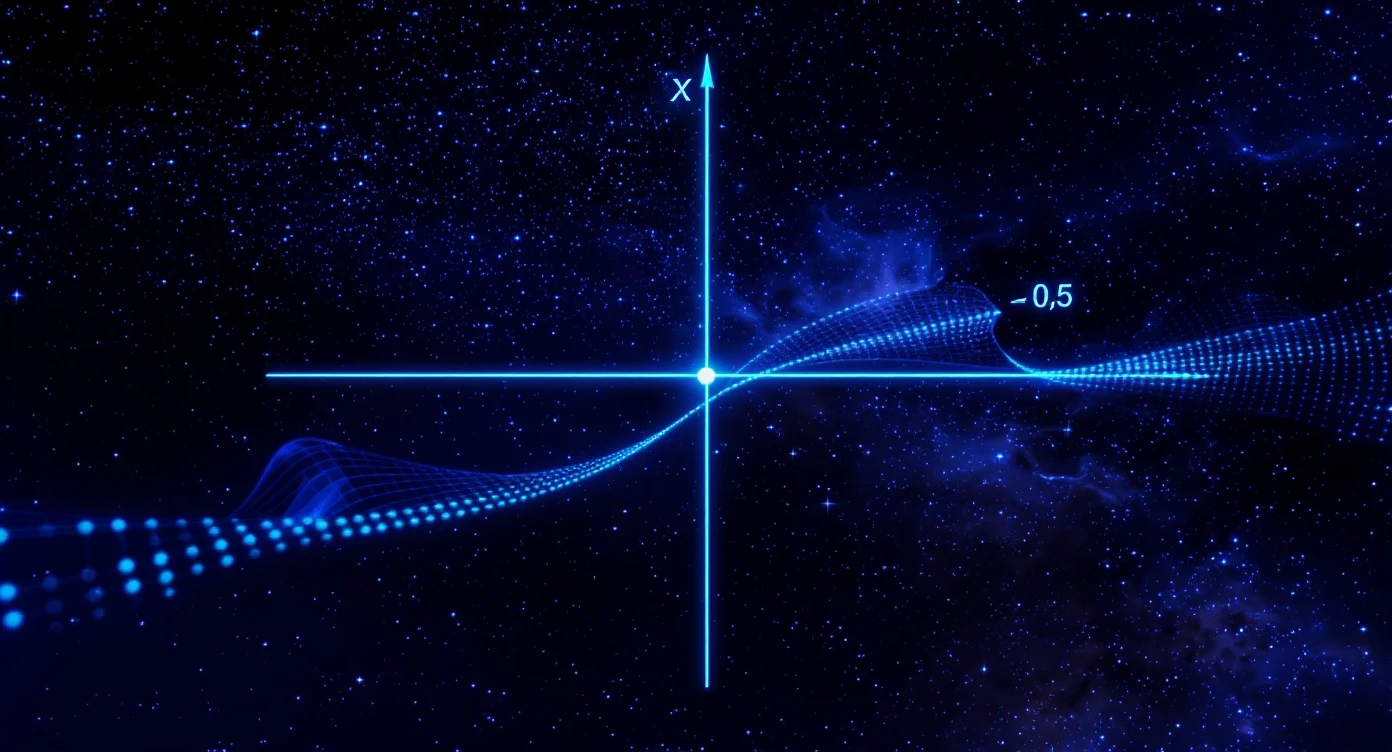
The Riemann Hypothesis: A Geometric Solution
The Riemann Hypothesis is the number one mathematical challenge of today. We offer a geometric solution that confirms the conjecture.
Aleph 0.5
Sequential whole-number fractions create Aleph 0.5 — an infinite set between cardinal and real numbers, directly challenging the Continuum H...

Solving the Russell Paradox: A 2D Geometric Solution
A 2D geometric resolution to the Russell Paradox and Continuum Hypothesis by folding whole and reciprocal number space on a square plane.
A Geometric Solution to the Russell Paradox
A geometric resolution to the Russell Paradox — one of mathematics' deepest challenges — by folding number space rather than restricting it.
Solving Infinity
By assessing the nature of numbers, base systems, and solving infinity, we lay the foundations for a solution to the Russel paradox and more...
Types of Infinity (into 2 & 3)
Not all infinities are the same. Geometric Maths shows how the square and triangle each generate distinct infinite structures in number theo...
8 Infinities on the Number Line
The number line contains 8 distinct infinite boundaries. Recognising them restructures the number line into a square, resolving the Continuu...
Zero²
ZERO² is a geometric function that rotates the entire number line at 90° to the original, to produce an X,Y co-ordinate system.
What is the Continuum Hypothesis?
The Continuum Hypothesis was the #1 mathematical challenge set by Hilbert at the start of the 1900s. It was only ever solved in the negative...
Reciprocal Number Space
There are more numbers in reciprocal number space than all whole numbers in existence. How can this be, and what does this tell us about inf...
The Zero Boundary
The Zero Boundary divides the infinite sets of positive and negative numbers, and is defined by the process of division.
The Infinity of ONE
The number ONE acts as an infinite boundary on the number line — no root can cross it. Discover how ONE and ZERO divide numbers into four re...
Zero begins and ends all numbers
By examining reciprocal numbers, we show that zero both begins and ends all numbers — making it the mirror image of infinity itself.